



Taking notes is not just about writing things down. The way you take notes affects how well you understand and retain information. The right note taking method can help you stay focused and learn faster. In this guide, you will learn a dozen methods and techniques for taking notes, how they work, and when to use each one.
What Are Note Taking Methods?
Note taking methods are different ways or strategies to capturing and organizing information.
Instead of writing random notes and trying to keep up with the speaker, you follow a clear system. This makes your notes easier to read, review, and use later.
For example, instead of writing long paragraphs, you might use headings, diagrams, or bullet points to organize ideas.
The Way You Take Notes Matters

Your note taking method plays a big role in how well you learn.
Good note taking helps you:
- Understand information more clearly.
- Remember key ideas longer.
- Stay focused during meetings or lectures.
- Review content faster.
- Turn notes into reports or articles.
For people who work in an office and have many meetings each day, good notes make it easier to turn what is discussed into a plan of action or an executive summary.
The fastest way you can save yourself time and energy is by automating your note taking with an AI Note Taker like Summary AI. The platform can join your calls, transcribes everything, and creates a summary with all action items and key points highlighted.
How to Choose the Best Note Taking Method
There is no single best method for taking notes that suits everyone. The right choice depends on your situation and what you need the notes for.
Think about:
- The type of content: Is it structured, fast-paced, or creative?
- Your learning style: Do you prefer visual or linear formats?
- Your goal: Are you studying, brainstorming, or organizing work?
- Your tools: Are you using paper, Notion, Google Docs, or AI tools?
For example, a lecture at university works well with the Cornell method, while brainstorming ideas works better with mind mapping.
Top Note Taking Methods
Now that you know how to choose the best note taking method, browse the list of the top techniques below and try a few options to see which one you find most useful.
1. Taking Notes with AI
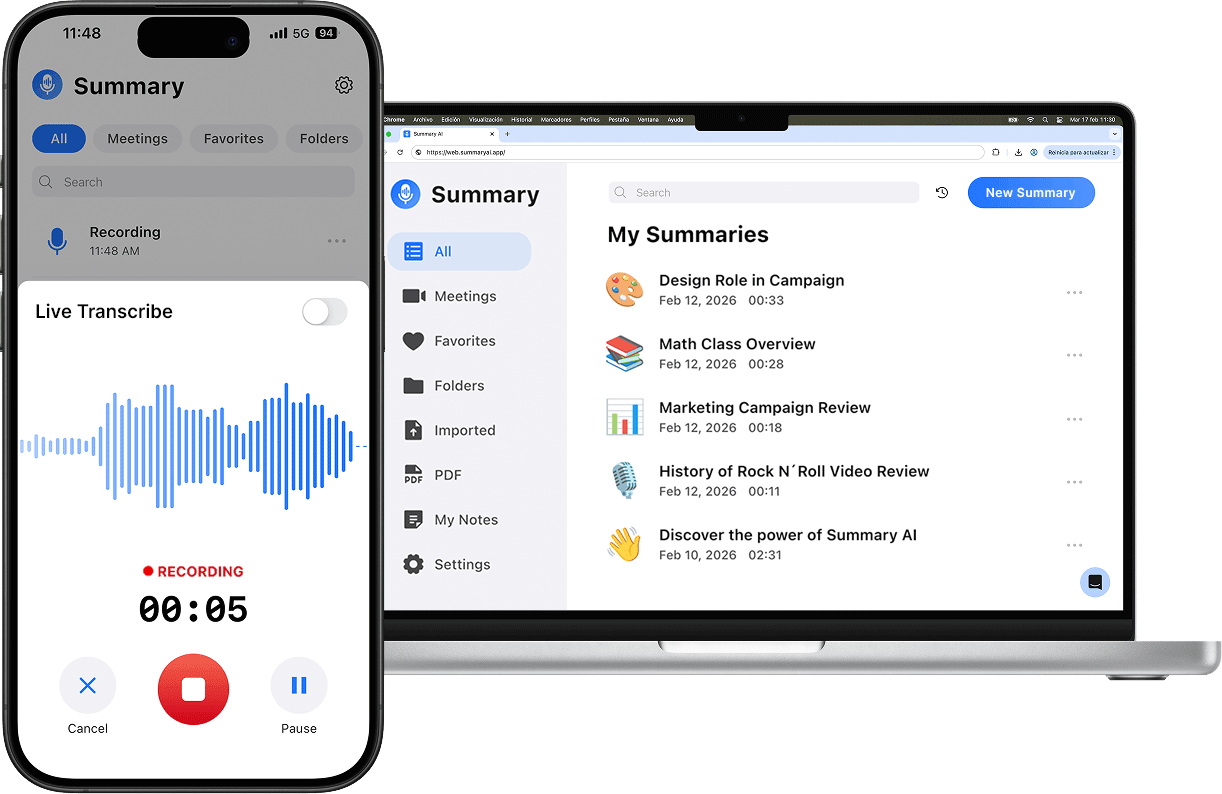
Taking notes by hand has always meant splitting your focus, especially during meetings and lectures, listening while writing at the same time.
AI note takers like Summary AI were built to solve that problem by handling the note taking for you entirely. This method is best for all sorts of people who attend many meetings, lectures, and calls, like professionals, students, journalists. It is the perfect AI meeting notes app for anyone wants to stay fully present without missing anything important and still get perfect notes at the end.
What is it
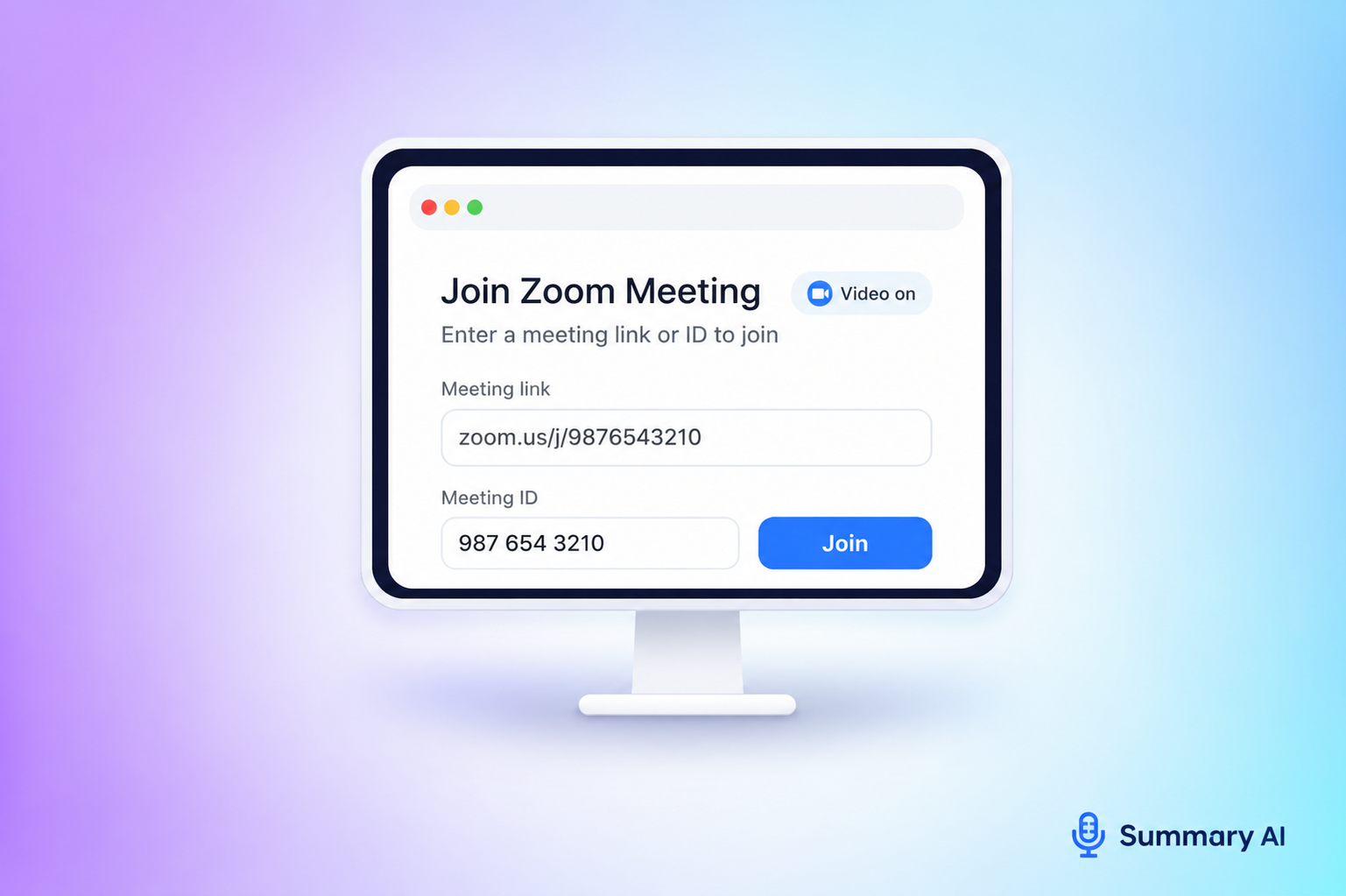
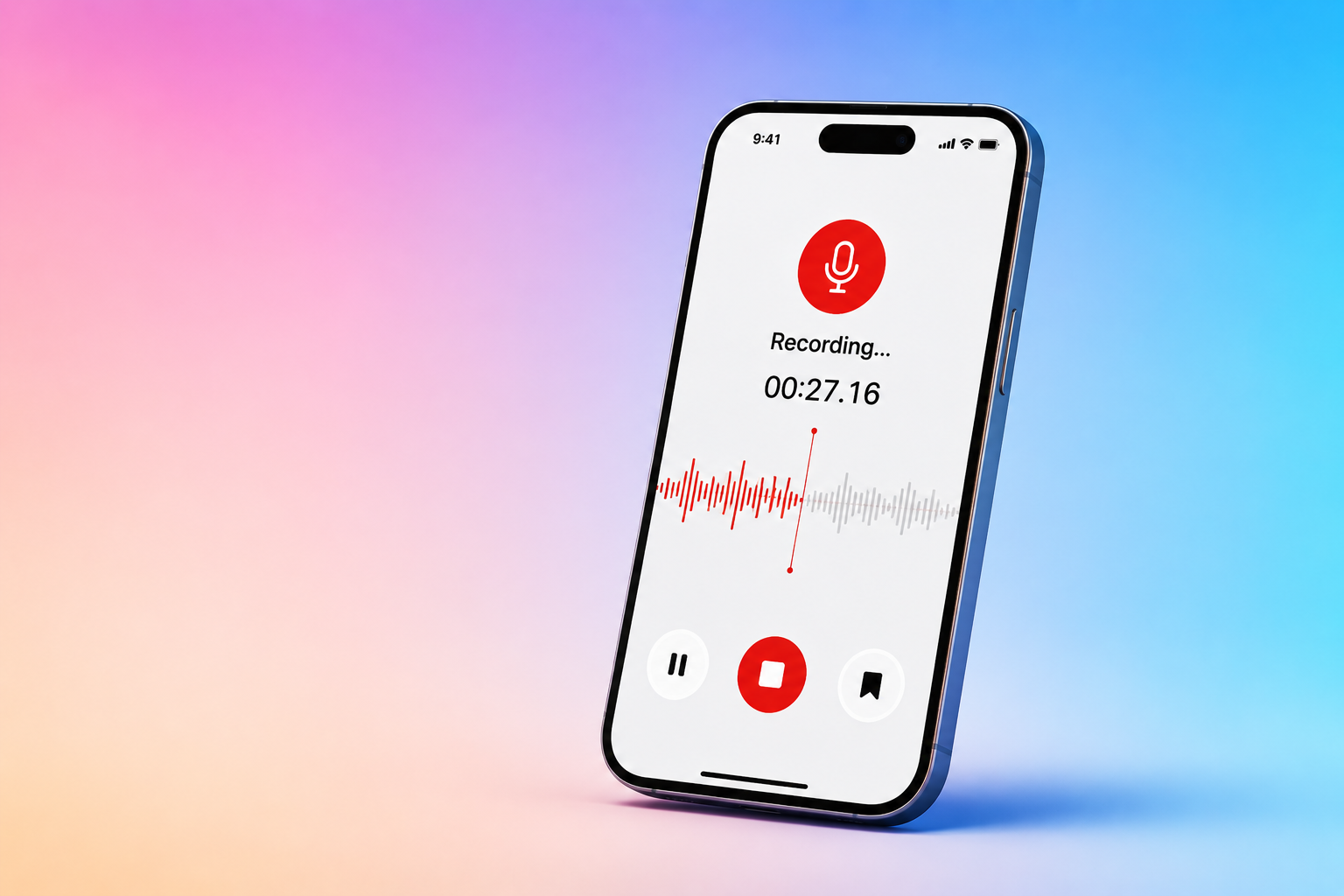
Summary AI is an app that automatically records, transcribes, and summarizes spoken content and turns it into clean, structured notes without any manual effort. It integrates with all the popular video meeting tools like Zoom, Meets, and more.
2. The Cornell Note Taking Method
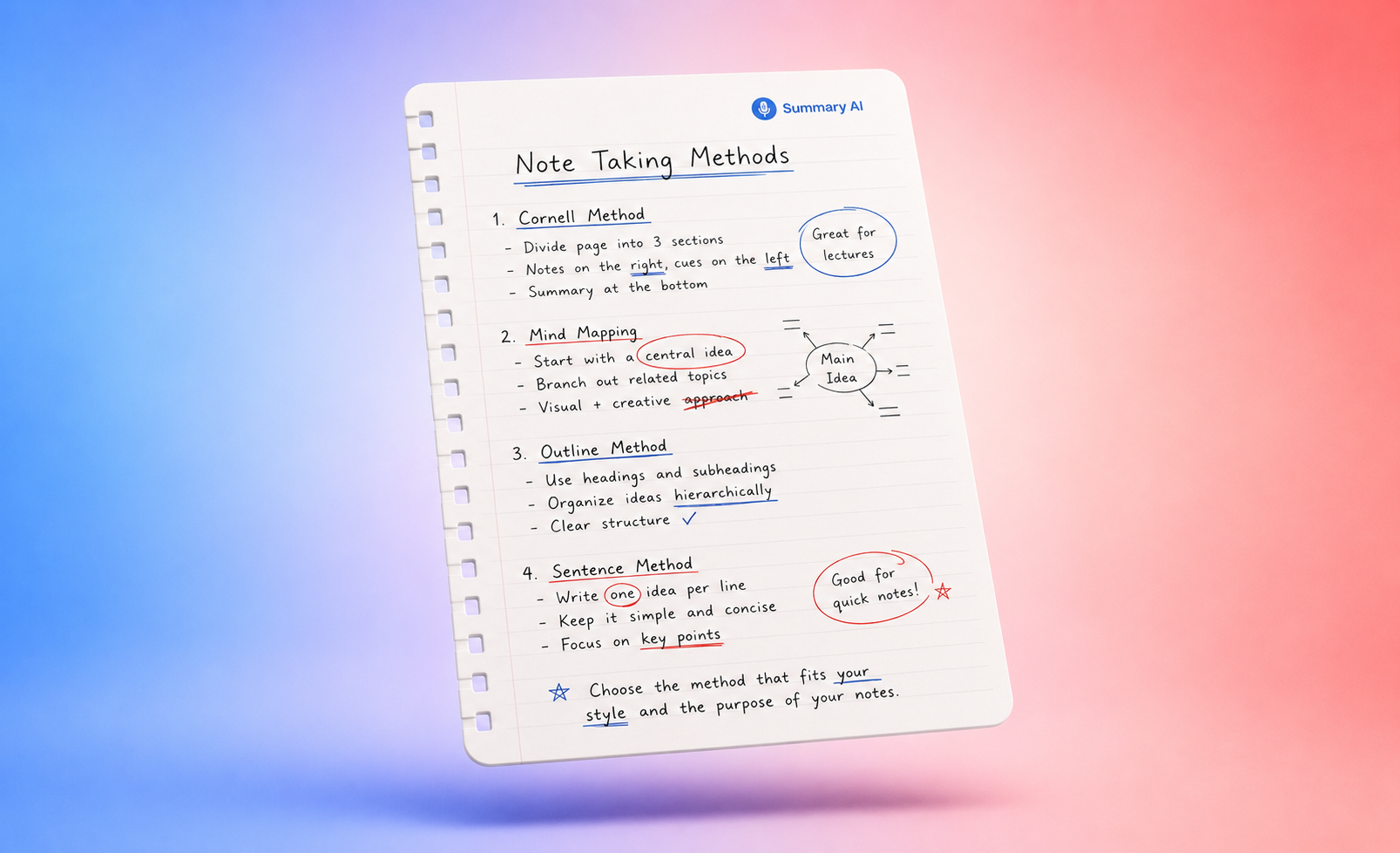
Developed in the 1950s by a professor at Cornell University, this method was designed to help students study smarter, not harder. It’s one of the most popular note-taking systems in schools and works best for students, people attending training sessions, or anyone who wants a quick way to review what they’ve learned.
What is the Cornell method
The Cornell method splits your page into three sections: notes, cues, and a summary. This way your notes are already organized and ready to review when you’re done with the les.
How to use the Cornell method
- Divide your page into three parts: a big notes section on the right, a narrow column on the left, and a small box at the bottom.
- During the session, write your main notes in the big section. Focus on key points, not every single word.
- Afterward, write questions or keywords in the left column. These are your study prompts.
- Write a short summary at the bottom in your own words.
- Later, cover your notes and use the left column to test yourself.
Best use case examples: Classes, training sessions, meetings.
3. The Outline Note Taking Method
The outline method is one of the oldest note-taking styles around, and you’ve probably used it without even knowing it. It works best when the material you’re studying is already well-organized, like a chapter of a book or a presentation, and suits people who like to see ideas categorized and sorted into a clear, logical order.
What is the outline method
The outline method organizes your notes in levels: main ideas at the top, supporting details in bullet points underneath, so it’s easy to see how everything fits together.
How to use the outline method
- Write the main topic at the top of your page.
- List your main points below it, each on its own line.
- Under each main point, list any details in bullet points or examples that support it.
- Use different levels of indentation if needed.
- After the session, review and tidy up the structure if needed.
Best use case examples: Textbook chapters, research notes, blog outlines.
4. The Charting Note Taking Method
If you’ve ever used a spreadsheet or comparison table, you already understand the logic behind charting. This method is great for researchers, students comparing topics for an exam, or anyone who needs to look at several categories of information side by side.
What is the charting method
The charting method organizes your notes into columns and rows, like a table, so you can easily compare different groups of information at a glance.
How to use it
Before you start, choose your categories. For example, you may name your categories: keyword, definition, and example.
- Draw a column for each category and label it at the top.
- As you take notes, fill in a new row for each new piece of information.
- Keep your entries short with just a few words or short phrase per cell.
- Review your chart afterward.
Best use cases: Comparing things, topics related to data, analysis and research.
5. The Mapping Note Taking Method
Mapping while taking notes helps you to think in connections. This approach works especially well for visual learners and anyone dealing with a topic that has lots of moving parts that relate to each other. Mapping is perfect for loose brainstorming sessions as well.
What is it
The mapping method uses a branching diagram to show how ideas connect to a central topic, making it easier to explore the branches more intuitively and see the full picture instead of just a list of facts.
How to use it
- Write your main topic in the center of the page.
- Draw lines outward to related subtopics.
- Add smaller branches from each subtopic for supporting details.
- Use arrows to show when two ideas are connected.
- Keep the layout spread out so it stays easy to read.
Best use cases: Complex topics and brainstorming sessions.
6. The Mind Mapping Note Taking Method

A more free version of mapping, the concept of Mind mapping was made popular by author Tony Buzan in the 1970s. It is very similar to the previous method on this list, but it is a bit more creative and freewheeling take on visual note-taking. It’s great for creative thinkers and anyone really who wants to explore ideas without feeling boxed in by a stricter structure.
What is mind mapping
Mind mapping is a colorful, flexible version of mapping. It encourages you to use colors, images, and shapes alongside words, which makes your notes more visual, personal, and helps most people memorize information more easily.
How to use it
- Put your central idea or question in the middle of the page.
- Branch outward with main themes, using a different color for each if you can.
- Add sub-branches with specific ideas or details.
- Use simple drawings or icons to represent key ideas visually.
- Don’t stress about structure and just let your thoughts flow and organize later.
Example: A marketer planning a campaign might create a mind map that branches out into audience, channels, content ideas, marketing automations, and metrics, then explore each one further to see how they can be connected.
7. The Sentence Note Taking Method
The sentence method is as simple as note-taking gets. It involces no templates, no rules. It’s the go-to approach for anyone who needs to capture information fast, like taking meeting notes or a during class.
What is it
The sentence method means writing each new idea as its own short sentence, one after another, as quickly as you can.
How to use it
Write each new idea on its own line as a short sentence.
- Keep it brief with one sentence per idea.
- Speed matters more than perfect wording here.
- If you have time, leave small gaps so you can add notes later.
- After the session, go back and highlight or reorganize the most important points.
Best use cases: Fast-paced lectures, brain dumps, quick notes.
8. The Flow Note Taking Method
Learning expert Scott Young developed the flow method as part of his approach to “learning things quickly and deeply.” It’s different from most note-taking systems because the goal isn’t to write everything down. The real goal is to actually understand what you’re hearing or reading in the moment. It works best for self-directed learners who are in the process of tackling tough material.
What is flow note taking
Flow note taking is about understanding ideas as you go, not just recording them. You write things in your own words and connect concepts as you learn.
How to use it
- Listen or read actively and resist writing everything down word for word.
- Write ideas in your own words so you actually process them.
- Use arrows or lines to connect related concepts on the page.
- Add your own questions or thoughts as they come to you.
- Focus on understanding the meaning, not creating neat notes.
Best use cases: Deep learning, problem solving, complex topics.
9. The Boxing Note Taking Method
The boxing method has become especially popular with AI note taking apps like Notion and GoodNotes, where creating and moving boxes is quick and easy. It’s a great choice for visual learners or anyone who covers several different topics in one session and wants to keep them clearly separated.
What is the boxing method for notes
The boxing method groups related notes inside boxes with one box per topic so your page is easy to scan and nothing gets mixed up.
How to use it
When a new topic comes up, draw a box on your page.
- Give each box a clear title or label.
- Write all notes related to that topic inside its box.
- Start a new box whenever a new topic begins.
- If two topics are related, place their boxes near each other on the page.
Best use cases: Visual learners, sessions covering multiple topics, brainstorming.
10. The List Note Taking Method

The list method is the most natural note-taking style there is. Most people use it automatically without thinking of it as a system at all. It’s fast, simple, and works in almost any situation, which makes it a default way to take notes for everyday situations.
What is the list method of note taking
The list method is really simple. It captures information as a series of bullet points or numbered items.
How to use the list method
- Write a heading at the top to keep your list focused.
- Add each new piece of information as a bullet point on a new line.
- Keep entries short with a word, phrase, or brief sentence.
- Use numbers if the order matters or use bullets if it doesn’t.
- After the session, highlight or group the most important items.
Best use cases: Meetings, to do lists, quick summaries.
11. The PARA Method for Note Taking
PARA was created by Tiago Forte as part of his “Building a Second Brain” system. It’s designed for people who end up with a lot of notes, files, and ideas across multiple tools during their work. If you are juggling lots of projects at once, PARA can help bring some sort of order to that chaos.
What is it
PARA is a system for organizing all your digital notes into four categories: Projects, Areas, Resources, and Archives. Every note you save goes into one of these four categories.
How to use it
- Projects: Things you’re actively working on with a deadline (e.g., writing an article, studying for an exam).
- Areas: Ongoing parts of your life with no end date (e.g., fitness, finances, content strategy).
- Resources: Useful reference material you might want later (e.g., writing guides, how-to articles).
- Archives: Finished projects or stuff you’re done with but want to keep.
Set up these four folders in the note app you want to use, for example Notion, Google Docs, or Obsidian, and sort every new note into one of them as you go.
Best use cases: Organizing digital notes and knowledge management.
12. The QEC Note Taking Method
QEC comes from academic settings where thinking critically about information matters as much as recording it. It’s especially useful for students and researchers who aren’t just collecting facts. They also need to analyze and draw conclusions from what they find. If you write essays, do research, or work on analysis tasks, this method helps you understand the topic you are taking notes on.
What is the QEC method of notes
QEC stands for Question, Evidence, Conclusion. It’s a three-step framework that turns your notes into a process: you start with a question, gather evidence, and work toward an answer.
How to use it
- Question: Write down the question or problem you’re trying to figure out. This keeps your notes focused.
- Evidence: As you read or listen, note down facts, data, quotes, or arguments that relate to your question.
- Conclusion: After gathering your evidence, write a short conclusion. What did you learn, and what does it all point to?
- Repeat the cycle for each new question or subtopic you’re exploring.
Best use cases: Research, essays, analysis.
Which Note Taking Method Is Most Efficient?
No surprises here, but there’s no single best method for taking notes. The most efficient method is whichever fits your goal in that moment. A student reviewing for an exam has different needs than a writer brainstorming a novel, and both have different needs than a manager jumping from meeting to meeting.
A few general rules tend to hold true across situations:
- Match the method to the content: while discussions with a strict agenda calls for notes with more structure, creative or open-ended topics require a more flexible approach to note-taking
- Match the method to your speed: fast-paced situations call for a simple way of note-taking; slower sessions give you room for more elaborate formats
- Match the method to how you’ll use the notes: if you need to review and study later, build that in from the start, if you just need a quick reference, keep it light
- Match the method to your tools: digital environments open up options that paper doesn’t, for example with the PARA method, and vice versa
Most people don’t stick to just one method forever. The more you experiment with taking notes, the more naturally you’ll start mixing and matching based on the situation. Don’t worry what your notes look like as long as they fit their purpose and capture the info you need.
Get the best notes every time with Summary AI
For people with many meetings each week, taking notes can be a real hassle. It’s not just the amount of time they take to organize, it’s also the fact that while you take notes, the conversation goes on, and your focus is split when multitasking during meetings. Summary AI can take notes for you. It is a popular AI note taker that joins your calls, transcribes everything, and generates the perfect summary with key points highlighted and action items so you always know what to do next.