



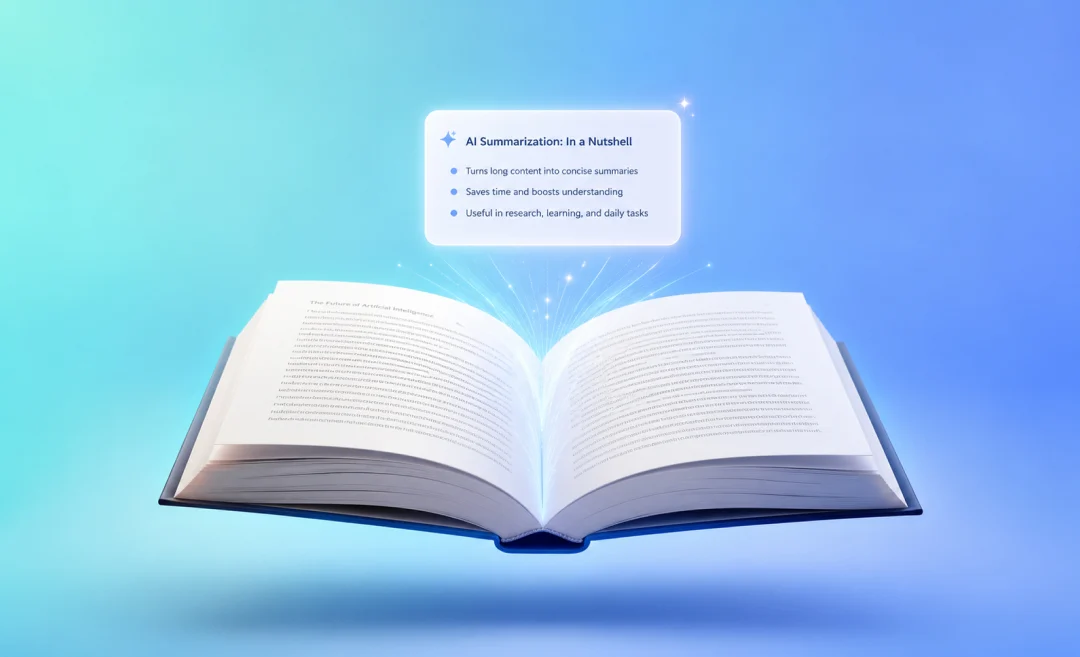



Summarization is a useful skill to learn. It is the skill of taking a long piece of information and turning it into a shorter version that still keeps the main ideas. When you summarize well, you remove extra details from the original piece, repeat ideas less, and keep only what is absolutely necessary to understand the topic.
Summarizing things is useful at school, at work, and in everyday life when you do not have time to read or listen to everything.
In this guide, you will learn what summarization means, the main types of summarization, how it works, which tools can help you, and how Summary AI can make meeting summaries much easier.
What summarization means

Summarization means “making something shorter while keeping the important parts.”
When you summarize a text, video, meeting, or email, you are answering the simple question of: “What are the key ideas here, in fewer words?”
A good way to think about summarization is:
- You remove examples, long explanations, and details that are only meant to color the story.
- You keep the main ideas, key points, and most important conclusions.
- You rewrite the content in your own words, in a shorter form.
A simple example of a summary
To understand what a summary means, imagine a three‑page article explaining how solar panels work, for example.
A summary of this article might be three short paragraphs that explain what solar panels are, how they turn sunlight into electricity, and why people use them, without going into every small technical detail. We’ll look at what else a summary consists of in the next sections of this article.
If you want a deeper walkthrough of making a summary step by step, you can read our guide on how to make a summary. It explains the process of creating a summary and gives you a method you can use every time.
Summary AI is a tool for creating AI transcriptions that automatically summarizes your meetings for you. Invite it to your calls so you get perfect notes every single time!
Types of summarization

Even though the meaning of summarization is always shortening and condensing information, there are several types depending on what you are summarizing and how you do it.
Text summarization
This is the most common type of summary. You take written content like:
- Articles
- Books or chapters
- Reports
- Blog posts
and turn them into shorter texts. This could be a single paragraph, a few bullet points, or even a one‑page summary.
There are two main styles of summary:
- Informal summaries are similar to notes you write for yourself before an exam. Reading more on taking meeting notes can help learn how.
- Formal summaries are more like an abstract at the start of a research paper or an executive summary in a business report.
Our guide on how to summarize an article that shows you how to turn long articles into short and clear summaries without losing the main message.
Audio and video summarization
Here, you are summarizing spoken content, such as:
- Meetings and calls
- Lectures and classes
- Webinars and podcasts
- Interviews
The usual steps for creating this kind of summary are:
- recording
- transcribing (turning audio into text)
- and then summarizing that text.
AI transcription tools like Summary AI work especially well for this kind of summarization, because meetings are often long and messy, and people rarely have time to rewatch or reread everything, especially people who have dozens of meetings each week.
Email summarization
Email summarization means turning long email threads into short notes that explain:
- What the email/s is/are about
- What decision has been made
- What the next steps are
- When to follow up
Summarizing emails is very useful, especially when you come back from a break and see a full inbox with a long email thread with many replies. A short summary can save you from spending hours going through your inbox reading every single line just to figure out what matters.
How summarization works

Summarization can be a simple process with a few clear steps.
1. Understand the original content
You cannot summarize what you do not understand. The first step is to:
- Read or listen carefully.
- Ask yourself: “What is this about?”
- Make sure you can explain it in a sentence or two in your own words.
If you are struggling to see what matters in what you are trying to summarize, it often helps to look for:
Titles and subheadings
Topic sentences at the start of paragraphs
Repeated ideas and phrases
Knowing how to identify key points is very useful here. It teaches you how to spot the main ideas inside long content, which is the core of good summarization.
2. Pick the key points
Once you know what the content is about, you look for the key points. These are the ideas that:
- The content repeats or builds on
- Directly answer the main question
- State a conclusion, argument, or important fact
- Key points are not small examples or details.
For instance, in a long article about climate change, key points might be:
- Main causes
- Main effects
- Possible solutions
Small stories and extra details can usually be left out of the summary.
3. Remove extra detail and repetition
At this stage, you:
- Cross out or ignore examples, long anecdotes, and extra explanations.
- Drop repeated ideas that say the same thing in different ways.
- Keep a short list of the few points that really matter.
This is where the summary becomes shorter than the original. You are not changing the meaning, you are just trimming the fat.
4. Rewrite in your own words
A good summary is usually written in your own words. That means you:
- Avoid copying full sentences from the original (unless you are quoting on purpose).
- Use simple, clear language.
- Keep the same meaning and tone.
If you are summarizing for work or school, you may also change the shape of the content. For example, you might turn a long email into a short paragraph and a bullet list of action items or a few lines that you can copy-paste into a task manager.

Summarize meetings with Summary AI
The meaning of summarization may be easy to define, but doing it well is something you need to learn. Summarizing in practice is the art of turning too much information into just enough. You can do it by hand with pen and paper, use apps, or, if meetings are what you need to summarize, you can rely on AI transcription tools like Summary AI. It will help you by joining your calls and meetings, transcribing everything, then generating the perfect summary with a list of action items and key points. It’s the best tool for people who have a lot of meetings every week. Check it out for yourself and start saving time on summaries!