



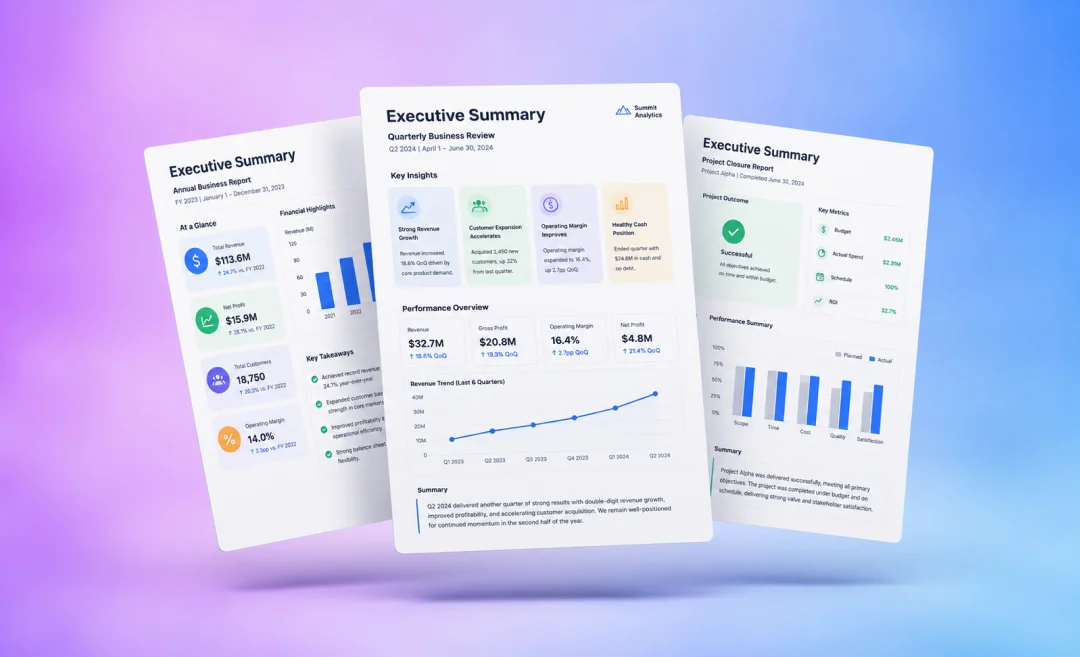



An executive summary is a short overview of a longer document such as a business plan, report, or proposal. It states the most important information giving readers a way to quickly understand the purpose of the document, review the key findings, and get recommended actions.
If you are asking what should be in an executive summary, how long it should be, or what the correct format is, this guide gives you a complete explanation and shows you how to write one.
Executive summaries are most commonly used in business and marketing because they help decision-makers save time. Instead of reading a document from start to finish, they can rely on the executive summary to understand what matters most and what action to take.
In this guide, you will learn what an executive summary is, what it includes, how it should look, and most importantly, how to write one effectively.

What is an executive summary
An executive summary condenses a longer document. This condensed version focuses on key points and gives recommendations on what action to follow up the findings with. It is designed for readers who need a quick understanding without going into full detail.
Even though an executive summary appears at the beginning of a document, it is almost always something you write last. This way the summary reflects the contents of the full document accurately.
According to the U.S. Small Business Administration, an executive summary (when used for business) should contain a clear explanation of your business goals and your strategy in a concise format. It should not introduce new ideas but instead summarize the information already written down in the document.

Executive summaries are commonly used in:
- Business plans for investors
- Project proposals and funding requests
- Financial and audit reports
- Consulting and strategy reports
- Research and academic documents
- Marketing plans and performance reviews
An effective executive summary answers three essential questions:
- What is this document about?
- Why is it important?
- What should happen next?
It should also be clear enough that someone can read only the summary and still understand the main message of the full document.
A good starting point to improve your summarizing skills is to read our guide on how to make a summary.
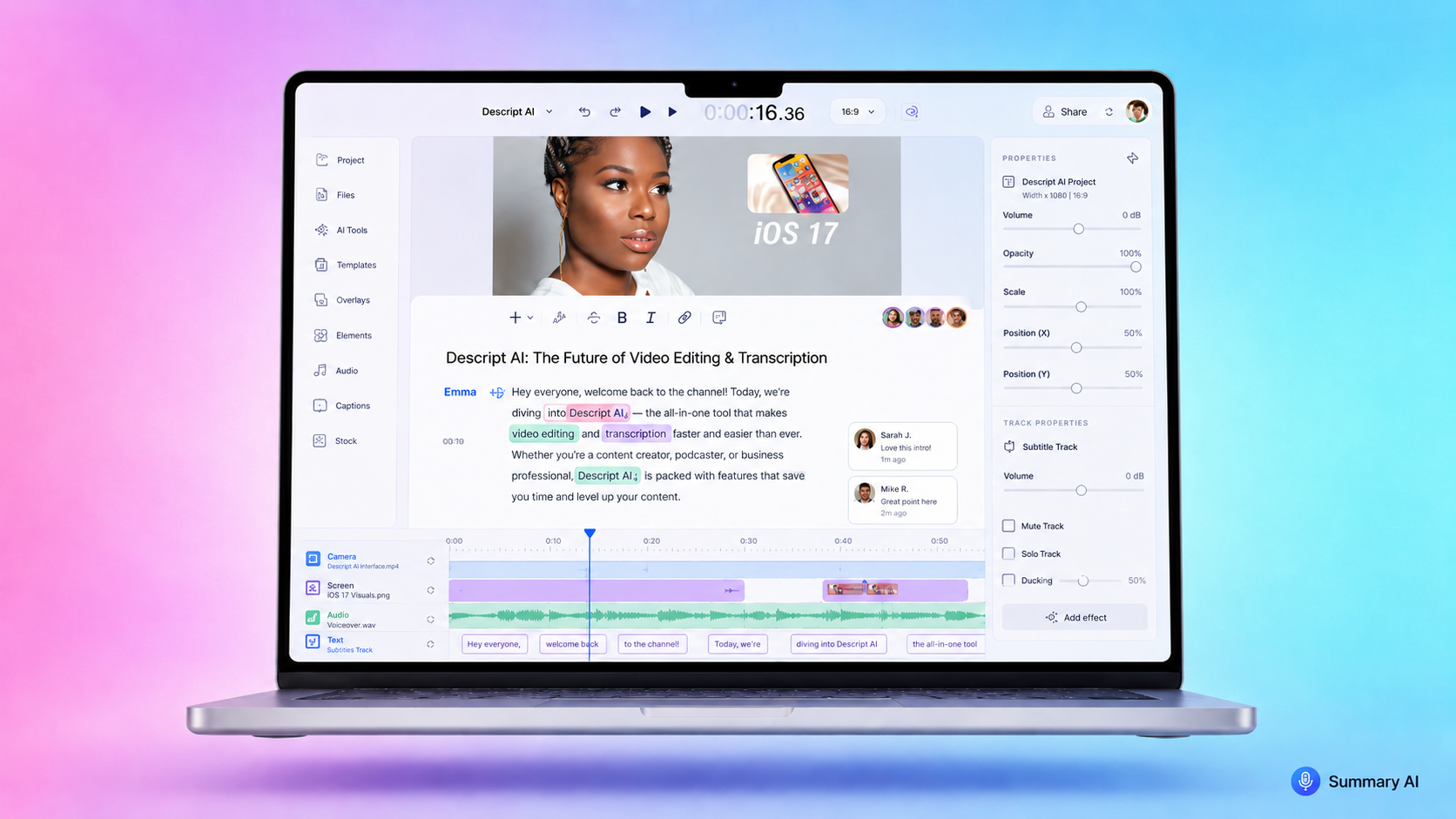
If you are in a hurry AI Summaries can turn long meetings into clear text you can scan in seconds in a few clicks.
How long should an executive summary be
The ideal length of an executive summary depends on the size of the original document and how complex it is. However, the main goal to keep in mind when creating an executive summary is always the same: keep it concise while covering all the key points.
Typical guidelines for how long an executive summary should be:
- 5% to 10% of the full document
- Around 1 to 2 pages for business plans
- 150 to 300 words for shorter documents
- Up to 500 words for more detailed documents
The summary should never feel too long or too difficult to read. If it takes too much time to understand, it loses its purpose.
Things to know when writing your summary:
- Focus on results and outcomes, not process
- Remove details that will not affect decisions
- Avoid repeating the same idea in different ways
- Keep sentences short and clear
- Use simple language that is easy to understand
Think about the length of your executive summary like this: if a reader can understand the full message while scanning the summary, the summary is effective. Don’t include more info than absolutely necessary.

What does an executive summary include
An executive summary includes only the most important information. It should give you a complete overview without being overwhelming.
The main elements an executive summary includes:
- Purpose: What the document is about
- Context: The problem, goal, or situation
- Key findings: The most important insights or biggest results
- Recommendation: What action should be taken
- Impact: Expected outcomes or benefits
You should connect each of these elements logically so the reader can follow the narrative from problem to solution.
What is the format for an executive summary
The format of an executive summary is simple. It shouldn’t be distracting and make sure the format you use helps organize ideas in a way that is easy to read and understand.
Standard structure for executive summary
Remeber to keep it short and concise. Your summary should be scannable. Here’s the basic structure you can use as a starting outline for your executive summary:
- Opening statement: defines the scope of the document
- Background or context
- Key findings or insights
- Recommended action or strategy
- Conclusion or next steps
This format works across most industries and scenarios, including business plans, reports, and proposals. You can use this outline as the basis for almost all document types and their summary sections.
How should an executive summary look like
The layout of an executive summary affects how easily it can be read. A well-structured summary improves comprehension and keeps the reader engaged.
Best practices for designing executive summaries:
Remember to keep it simple. Here are a few tips on how to do keep your summary easy to scan:
- Use short paragraphs
- Use clear spacing and a plenty of white space
- Break up large blocks of text
- Keep sentences short and simple
- Use bullet points when you can
- Highlight important results or outcomes
For other (visual) formats such as presentations or decks, the executive summary should be even more concise. It should focus only on the most important points and avoid going into extra details.
How to begin an executive summary
The opening of an executive summary is the most important part because it sets the context for everything that follows.
A strong opening should:
- Define what the document is about clearly
- Explain the purpose of the document or project in one or two sentences
- Give immediate context for the reader
After the opening, the summary should quickly move into key insights or findings without an unnecessary introduction.
How to write an executive summary
Writing an executive summary is about more than simply shortening the content. You need to know how to select the most important ideas and present them clearly in order to create a proper executive summary.
Here’s a step-by-step process you can follow:
- Review the document: Read the entire document carefully and understand its main message.
- Identify key points: Focus on insights, results, and recommendations.
- Group related ideas: Combine similar points to improve clarity and flow.
- Write a first draft: Use simple language and focus on clarity rather than detail.
- Edit and refine: Remove unnecessary words, repetition, and complex phrasing.
- Check accuracy: Make sure the summary reflects the original document correctly.
- Adjust tone and structure: Make sure the summary matches the audience and purpose.
If you often work with written content, you may also want to learn how to summarize an article and maybe even how to summarize an email.

Where to use an executive summary
Executive summaries are used in many different kinds of professional contexts where understanding the point of a document quickly is important.
Common situations where you might find executive summaries include:
- Business plans for investors and stakeholders
- Project proposals and funding requests
- Financial and audit reports
- Consulting and strategy reports
- Marketing plans and campaign reviews
- Internal updates and performance reports
They are especially useful when presenting to decision-makers who need clear insights without having the time to review full documents.
In your workflows, many teams use automation to speed up this process. Tools like a text simplifier can extract key points from meetings, reports, and presentations instantly, helping teams stay aligned and save time. Browse the best AI summary tools to see if you can find other ways to save time in your work.
Get an instant summary after every meeting
If you want to improve your team workflow, AI summaries can save you hours of time each week and really increase the productivity of your team. Without good meeting notes, your meetings are less useful than they should be.
A good meeting transcript only gets you halfway when it comes to executive summaries. You still need a good AI note taker, otherwise you are wasting a lot of precious time.
Summary AI can join your calls, transcribe them, and email you a perfect summary with keypoints and action items so you don’t need to write them yourself.