




Artificial intelligence has completely changed how we search, learn, and communicate. From quick Google searches to complex problem-solving, AI tools like Summary AI, ChatGPT, and Claude are now part of everyday life.
But here’s the secret — the quality of your results depends on how you ask your questions.
In this guide, you’ll learn how to ask AI questions effectively, examples of great prompts, common mistakes to avoid, and how Summary AI’s AI Chat can become your personal, always-available smart partner.
Why Asking AI Questions Matters

Asking AI questions isn’t just about curiosity, it’s about unlocking the full potential of artificial intelligence.
When you know how to communicate with AI effectively, you can:
- Save time finding answers or writing summaries
- Make better business and academic decisions
- Turn complex data into clear insights
- Automate repetitive research tasks
- Improve productivity and creativity
“AI isn’t replacing your thinking — it’s amplifying it. The better your questions, the smarter your results.”
What Does It Mean to Ask AI a Question?
When you “ask AI a question,” you’re giving a prompt — a set of words or instructions that the AI uses to generate a response.
AI systems like Summary AI’s Chat Assistant analyze your prompt, identify the intent behind it, and create a relevant, natural-language answer.
Examples of AI Question Types
| Question Type | Example Prompt | What It Does |
|---|---|---|
| Factual | “What are the top 5 translation apps in 2025?” | Retrieves accurate data and comparisons |
| Creative | “Write a catchy product slogan for a tech startup.” | Generates ideas and copy |
| Analytical | “Compare Zoom and Google Meet for business meetings.” | Evaluates pros and cons |
| Summarization | “Summarize this YouTube video in 3 bullet points.” | Extracts key information |
| Language-based | “Translate this paragraph into Spanish.” | Converts text to another language |
AI doesn’t just “know” things — it learns how to respond by understanding context, tone, and your goal.
How to Ask AI Questions Effectively
The art of prompting is simple once you know the structure. Here’s how to make your questions work better.
1. Be Specific
Instead of asking:
“Tell me about marketing.”
Ask:
“Explain digital marketing strategies for small businesses in 2025.”
Specific prompts give the AI context and direction, resulting in precise, useful answers.
2. Provide Background or Intent
Add short context like:
“I’m a student writing an essay on renewable energy. Give me three strong arguments in favor.”
This tells the AI what role to assume and how to tailor the response.
3. Ask for Structure
If you want your answer formatted clearly, say so:
“Give me a step-by-step guide on how to record a phone call using Summary AI.”
The AI will respond in an easy-to-skim, structured layout, perfect for business or research use.
4. Use Follow-Up Questions
AI thrives on conversation. After your first answer, ask:
“Can you simplify that?” or “Give me an example for beginners.”
This refines the AI’s understanding and makes answers even more relevant.
5. Combine Questions with Actions
In Summary AI, you can record a meeting, then ask AI to summarize, analyze, or translate it instantly.
For example:
“Summarize the last 15 minutes of this meeting and highlight next steps.”
That’s real productivity, powered by smart questioning.
Best AI Tools to Ask Questions
| App Name | Best For | Key Features | AI Type |
|---|---|---|---|
| Summary AI | Productivity, transcription, summaries | Record, transcribe, summarize, translate, chat | All-in-one AI assistant |
| ChatGPT | Writing, idea generation | Conversation-based answers | Text-based AI model |
| Google Gemini | Search and research | Integrated with Google Search | Generative AI |
| Claude AI | Long-form documents | Context-aware responses | Enterprise AI |
| Perplexity AI | Research & citations | Web-linked answers | AI-powered search |
Unlike most tools, Summary AI combines chat, recording, and transcription: making it more practical for professionals and students.
How to Ask AI Questions in Summary AI
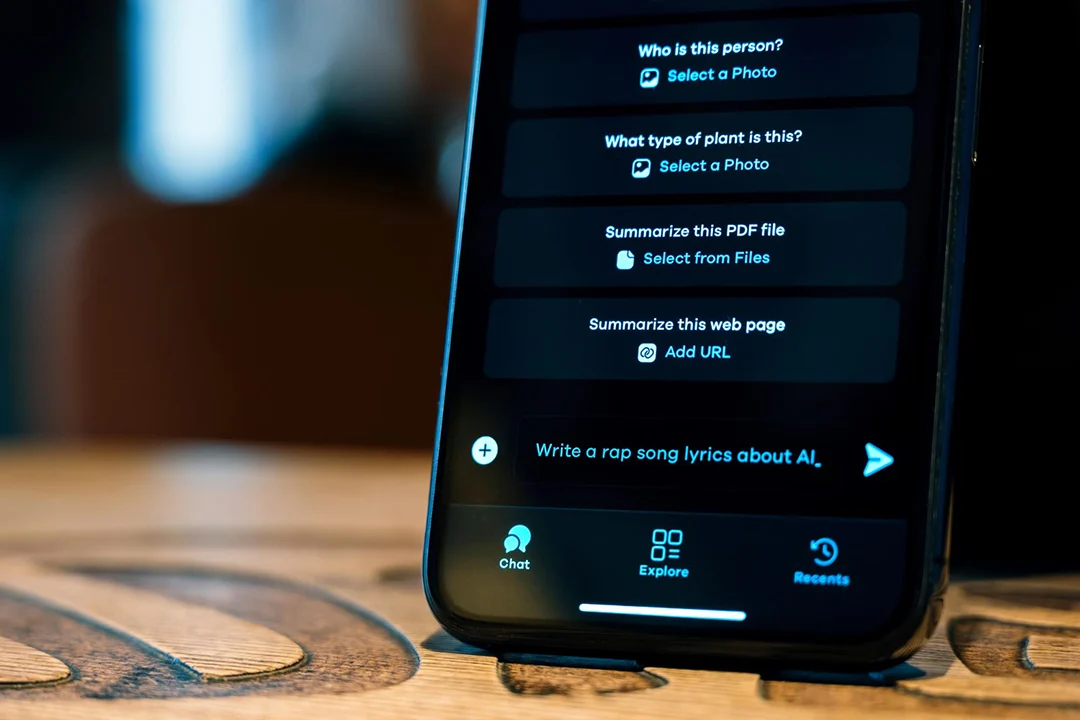
The AI Chat inside Summary AI is built for real-world scenarios — not just general questions.
Example Use Cases
For Professionals:
- “Summarize my last meeting in 3 sentences.”
- “Translate this client call into English.”
- “Give me key action items from today’s sales discussion.”
For Students:
- “Explain this podcast episode in simple terms.”
- “Summarize my lecture notes.”
- “Create a study guide from this audio recording.”
For Freelancers:
- “Generate a client proposal from this call transcript.”
- “Write an invoice follow-up email.”
- “Summarize the key deliverables from this project meeting.”
Pro Tip: You can record in the background while multitasking, Summary AI automatically transcribes and prepares answers for any follow-up AI questions.
How AI Understands and Answers Your Questions
Modern AI models like the one powering Summary AI Chat are built using natural language processing (NLP) and machine learning.
They analyze:
- Keywords and intent (what you want)
- Context (previous conversation or file)
- Tone (formal, casual, technical)
Then they predict the best possible answer using patterns from millions of examples.
So when you ask:
“How can I be more productive during meetings?”
The AI pulls from thousands of productivity frameworks, communication guides, and real-world examples, summarizing it all into a personalized response.
Common Mistakes to Avoid When Asking AI Questions
Even advanced users make mistakes. Here’s what to watch out for:
| Mistake | Better Approach |
|---|---|
| “Tell me about science.” | “Explain Newton’s laws in simple terms.” |
| “Make a report.” | “Create a 500-word report on remote work trends.” |
| “Summarize this.” | “Summarize this 20-minute podcast into 5 bullet points.” |
| “Translate this.” | “Translate this meeting transcript from English to Spanish with correct grammar.” |
Remember: AI isn’t telepathic: it’s a reflection of your clarity.
How Summary AI Is Redefining AI Q&A
Unlike chat-only tools, Summary AI integrates real-world context, recordings, transcripts, PDFs, and videos, and lets you ask questions directly about your content.
Example Workflow
- Upload a meeting recording or document.
- Ask: “What were the main client concerns?”
- Ask follow-up: “Summarize their budget expectations.”
- Get a custom AI summary and recommendations instantly.
This is where AI meets action: it doesn’t just talk, it analyzes your data.
The Future of Asking AI Questions
By 2025, AI assistants like Summary AI are evolving beyond basic Q&A. You’ll soon be able to:
- Ask questions in any language and get translated summaries instantly.
- Get emotional tone analysis in transcripts.
- Ask AI to automatically generate reports, follow-ups, or reminders based on your interactions.
AI won’t just answer your questions — it will understand your goals.
Key Takeaways
- Be clear, specific, and structured in your prompts.
- Provide context: tell AI what you need and why.
- Use Summary AI to combine recording, summarization, and Q&A in one platform.
- Avoid vague prompts: they waste time and reduce accuracy.
- Experiment and refine: AI gets smarter the more you interact with it.
“Asking the right question isn’t just smart — it’s an essential AI skill for the modern world.”
FAQs about Asking AI Questions
1. How do I ask an AI a question effectively?
Be specific, provide context, and ask for structure. For example, say “Summarize this meeting in bullet points” instead of “Summarize this.”
2. What kind of questions can I ask AI?
You can ask AI questions about meetings, lectures, projects, tasks, decisions, or written content. AI is especially useful for summarizing information, extracting key points, creating action items, and answering follow-up questions based on existing content.
3. Can AI answer personal or professional questions?
Yes. AI can help with both personal and professional questions, such as organizing tasks, clarifying information, improving notes, or helping you understand complex topics. However, it works best when answering questions based on provided content, recordings, or documents.
4. How is Summary AI different from ChatGPT or Google Gemini?
ChatGPT and Google Gemini are general-purpose AI chat tools. Summary AI is built specifically for recording, transcribing, and summarizing real conversations and meetings, with structured outputs like action items and key takeaways. In short, chatbots help you think and write, while Summary AI helps you capture, organize, and act on what was said.