




Why Your Podcast Needs a Transcript
In today’s crowded audio-landscape, simply publishing an episode of your podcast isn’t enough. To truly amplify your reach, boost discoverability, and engage more listeners, you need to pair your audio with a well-crafted transcript. Here’s why:
- Search engines can’t crawl audio, but they can crawl text. Including a transcript helps your podcast rank for keywords and topics.
- Accessibility matters. Offering a transcript opens your content to people who are deaf or hard of hearing, non-native speakers, or anyone in a noisy environment.
- Repurpose potential. A transcript gives you content you can reuse — blog posts, social posts, lead magnets.
- Better user experience. Listeners can search, skip and read specific parts of your podcast rather than hunt around in audio.
In short: if you’re creating a podcast but not offering a transcript, you’re leaving growth, accessibility and SEO on the table.
What Is a Podcast Transcript?
Definition & Core Components
A podcast transcript is a written version of the audio content in your episode. It typically includes:
- Speaker labels (Host, Guest, etc.)
- Timestamps or approximate time-markers (optional)
- Dialogue verbatim or near-verbatim
- Occasionally non-verbal cues (“[laughter]”, “[music]”)
The Role It Plays in Your Content Workflow
For creators and content marketers, a transcript is more than just text—it’s a source asset. From it you can:
- Extract key quotes for social media
- Write show notes or blog posts
- Optimize SEO with keywords mentioned in the episode
- Provide an accessible version for alternate audiences
Key Benefits of Transcribing Your Podcast

Let’s dive into the concrete benefits with bullet-points and references:
1. Accessibility & Inclusivity
- Improves access for listeners who are deaf or hard-of-hearing.
- Helps non-native speakers follow along and understand the content more easily.
- Accommodates listeners who prefer reading over listening or who are in environments where audio isn’t practical.
2. Search Engine Optimization (SEO)
- Text content allows search engines to index what your episode covers — keywords, themes, topics.
- Increases organic traffic to your podcast page or website.
- Makes long-tail keywords visible (phrases your listeners might search).
3. Content Repurposing & Marketing Leverage
- Use the transcript to craft blog posts, infographics, lead magnets, and social posts.
- Turn each episode into multiple content pieces — maximizing ROI of your audio-content.
- Provide downloadable transcripts for premium subscribers or email list sign-ups.
4. User Experience & Engagement
- Listeners can skip to relevant sections using timestamps. riverside.fm
- Improves show-notes quality by providing a full text base.
- Enhances credibility and professionalism of your podcast brand.
5. Archive & Reference Value
- Having a transcript creates a searchable archive of past episodes.
- Guests may quote themselves, increasing your visibility.
- Adds long-term value to your content library.
Methods for Generating Podcast Transcripts
Manual Transcription
Pros:
- Highest potential accuracy if done thoroughly
- Full control over formatting, speaker labels, non-verbal cues
Cons:
- Extremely time-consuming (human transcriber may spend 1+ hour per 10-15 minutes of audio)
- Costly if outsourcing
Automated AI Transcription Tool

Pros:
- Much faster turnaround — minutes rather than hours Top 5 Accessibility
- Lower cost
- Many integrate with podcast workflows or hosting platforms castmagic.io
Cons:
- Accuracy depends on audio quality, accents, noise
- Still requires proofreading and minor editing
Export & Reuse Mistakes
- Simply copying text into Word without cleanup may lead to awkward formatting.
- Forgetting to remove timestamps, speaker tags, or filler words hurts readability.
Tip: Use tools that allow export into Word or Office 365 formats and have editing built-in.
Hybrid Approach (AI + Human Proofing)
Many creators adopt a hybrid method: Use AI for the initial draft, then a human proofreads for accuracy, speaker identification, formatting. This gives a strong balance of speed and quality.
Where to Publish Your Transcript
- On your podcast website (dedicated episode page)
- As part of show notes or blog post
- Linked/downloadable via RSS feed (some podcast directories support <podcast:transcript> tag)
- As SEO-rich content on your domain
Comparison Table: Transcript Methods
| Method | Speed | Cost | Accuracy | Best Use Case |
|---|---|---|---|---|
| Manual Human Transcribe | Slow | High | Very High | Premium episodes, interviews |
| AI Automated | Fast | Low / Medium | Medium–High | Regular episodes at scale |
| Hybrid (AI + Proof) | Moderate | Medium | High | Balanced workflow |
Best Practices for Using Transcripts Effectively
1. Ensure Good Audio Quality
Clear audio, minimal background noise, isolated voices all improve transcription accuracy.
2. Edit & Format the Transcript
- Remove filler words (“uh”, “um”) if you want a cleaner read
- Add headings or timestamps for user navigation
- Identify speaker names
- Add links or resource references mentioned in the episode
3. Optimize for Keywords & SEO
- Use relevant keywords naturally within the transcript
- Include those keywords in headings, meta description, and alt text if you’ll publish it on your site
- Make sure the transcript text is included in the page HTML (not just behind a JavaScript load) so search engines can crawl it.
4. Repurpose Smartly
- Pull key quotes for social media or graphics
- Create blog posts summarizing the episode
- Offer the transcript as a PDF download for email opt-ins
- Combine multiple transcripts for an eBook or resource kit
5. Stay Accessible and Inclusive
- Publish transcripts for accessibility compliance and reaching broader audiences.
- Consider translation if you have an international audience
- Provide a searchable archive for users who prefer reading
6. Use Technology to Automate the Workflow
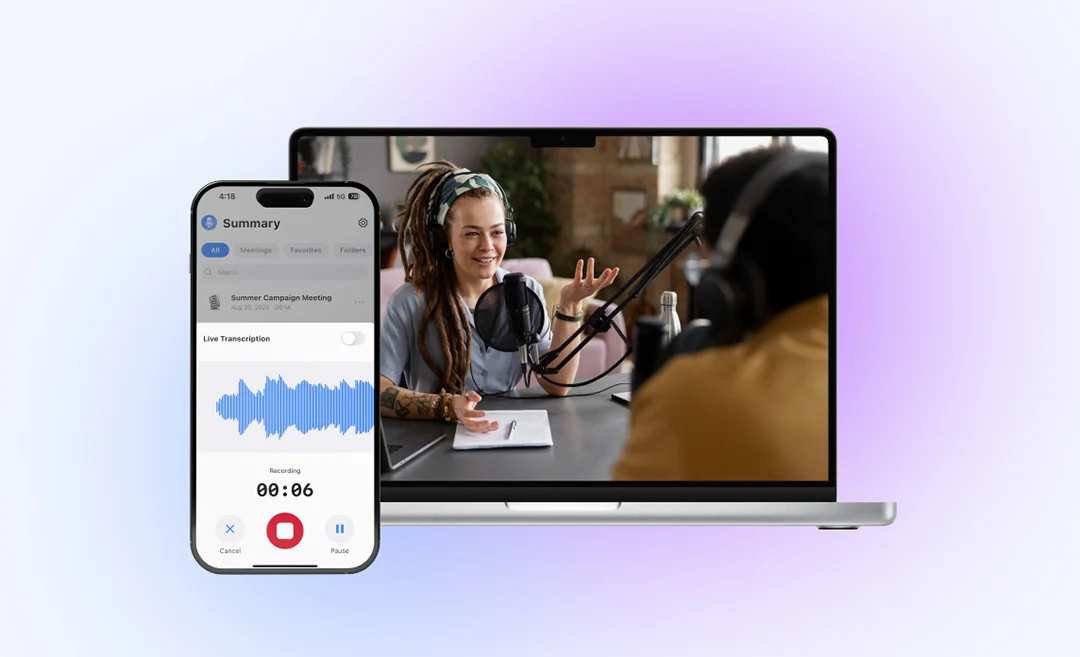
Using tools like Summary AI enables you to:
- Upload or link audio/podcast and get a transcript fast
- Export into Word, PDF, or blog-ready format
- Leverage AI to extract show notes, keywords, or highlights
Use Case Examples & Quotes
“Podcast transcripts allow your audience to follow along easily, access important sections, and absorb insights more thoroughly.”
“Podcast episode transcripts make your content more accessible, improve SEO, help you repurpose… build trust with potential subscribers.”
Case Example:
A solo podcast host started including full transcripts for each episode on his website. Within 6 months:
- Organic traffic to episode blog pages increased by 40%
- New listener sign-ups from blog readers rose by 25%
- The transcripts became lead magnets (downloads) for his email list
Common Mistakes to Avoid
Publishing transcripts with no formatting (just a wall of text) — make it readable
Not proofreading AI transcripts — errors or mis-heard words undermine professionalism
Hiding transcripts behind paywalls or PDFs only — better to publish text that search engines can index
Ignoring the resource potential of transcripts — don’t just publish, repurpose
Forgetting privacy/copyright if you’re transcribing guest content or music segments
How Summary AI Simplifies Podcast Transcripts
If you’re looking for a streamlined way to transcribe your podcast episodes, Summary AI offers key advantages:
- Quick transcription of audio to text with high accuracy
- Export options: Word, PDF, blog-ready formats
- Repurposing tools: Create blog posts, social graphics, email content from your transcript
- Accessibility features: Enhanced readability, searchability, and multilingual support
- Workflow efficiency: Time saved means you spend more time creating, not transcribing
Final Thoughts
In the modern podcasting ecosystem, producing the audio is just the start.
Adding a well-formatted, keyword-optimized transcript elevates your content from “just a podcast” to a full content asset. With benefits spanning SEO, accessibility, user experience, and repurposing opportunities, transcripts are a must.
If you want to accelerate your workflow, reach more listeners, and derive more value from every episode — make transcripts a non-negotiable part of your strategy. With tools like Summary AI, you can turn audio into text, then into blog content, lead magnets, and so much more at scale.
Ready to unlock the full potential of your podcast?
Try Summary AI and turn your next episode into a searchable, readable transcript — and then watch how your content workflows expand.
FAQs about Podcasts and Transcripts
1. What is a podcast transcript and why is it important?
A podcast transcript is the written version of your podcast’s audio content. It includes every spoken word, speaker labels, and sometimes timestamps. Transcripts improve SEO visibility, make your show more accessible, and allow you to repurpose content into blogs, social posts, or newsletters. By turning your episodes into searchable text, you help both listeners and search engines find and understand your content.
2. How can I create a transcript for my podcast?
You can create a podcast transcript manually or automatically using AI transcription tools like Summary AI. Simply upload your episode audio file and the AI will convert the audio to text in seconds. Summary AI also provides features for editing, summarizing, and translating transcripts, so you can publish them directly to your website or content management system.
3. What are the best AI tools for podcast transcription?
Some of the best AI transcription software for podcasts include Summary AI, Descript, Otter.ai, and Castmagic. However, Summary AI stands out for professionals because it not only transcribes but also summarizes episodes, creates meeting notes, and translates in real time. It’s ideal for creators, consultants, and marketers who want both speed and accuracy.
4. Are podcast transcripts good for SEO?
Absolutely. Podcast transcripts are one of the most effective ways to boost your podcast SEO. Search engines can’t read audio files, but they can index text. By posting a keyword-optimized transcript on your podcast website, you make each episode discoverable through organic search. This helps increase website traffic, listener engagement, and backlink opportunities from other publishers referencing your written content.
5. How accurate are AI-generated podcast transcripts?
The accuracy of AI-generated transcripts depends on the tool and the audio quality. High-end transcription apps like Summary AI achieve up to 98–99% accuracy, especially when the audio is clear and speakers are distinct. For best results, record in a quiet environment and review the transcript for minor edits before publishing.